
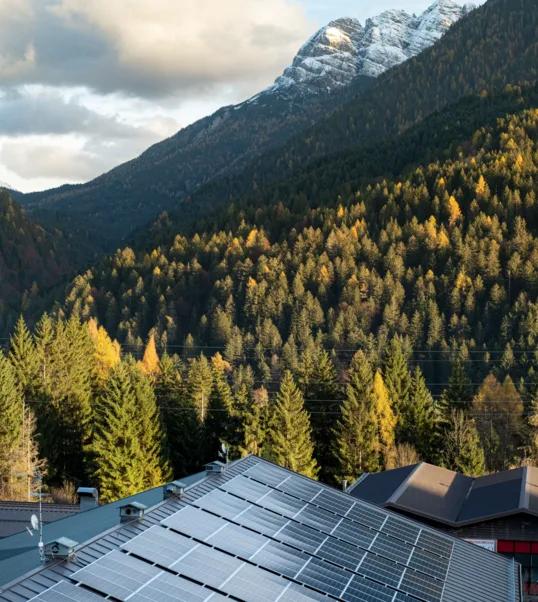
Solar Systems
Everything about solar systems

How it works
How your solar system produces energy and reduces costs.
Cost
Transparent costs and pricing structure at a glance.
Amortization
When your solar system starts paying off financially.
Solar carport system
A solar roof for your car – charge with your own solar energy.
Solar calculator
Determine your personal solar potential in just a few minutes.

Service
Maintenance, monitoring and support – all from one source.
Energy storage
Store your solar power and use it around the clock.
Repowering
Upgrade your existing system to the latest technology.
Guide
Solar in Austria: planning, costs, subsidies and yield
A photovoltaic system on your own roof produces electricity for 25 to 30 years. Here you will find what counts before you decide: how large the system should be, what it costs, what subsidies there are and how you can pay for it.
Is my roof suitable?
Almost any roof without heavy shading is suitable. A south-facing surface produces the most, but east-west roofs spread the power more evenly across the day and so often match your own consumption better. Each kilowatt peak of output needs around 5 m² of roof area.
An 8 kWp system typically produces 8,500 to 10,500 kWh a year in Austria, from about 1,070 kWh per kWp in Salzburg to 1,350 kWh per kWp in Innsbruck. Our solar calculator shows what your roof can deliver, using yield data from PVGIS, the European Commission's solar calculator.
How large should the system be?
In the past, a system was sized for current consumption. That is outdated, because a heat pump and an electric car increase electricity demand, and the fixed costs for scaffolding, planning and connection arise at any size. In most cases, it pays to make good use of the roof.
We size the system from your consumption, planned devices such as a wallbox or heat pump, and the feed-in tariff.
What does a solar system cost?
The price per kilowatt peak falls as the system gets larger. The roof, scaffolding, electrical installation and choice of inverter affect it, as does the question of whether a battery is added. You will find current prices per kWp and worked examples for 6, 10 and 15 kWp on our cost page.
When the system has paid for itself depends above all on the share of the electricity you use yourself. Every kilowatt hour you use yourself replaces electricity at the grid tariff, while every kilowatt hour you feed in earns only the feed-in payment.
Subsidies, feed-in and taxes
The federal government has funded solar with the EAG investment grant paid by OeMAG. The 2026 funding calls are closed, and a bonus for storage systems is announced for 2027. Some federal states add their own grants, for example Carinthia for systems with storage. We check what applies at your address when we prepare the offer. Our prices never assume a subsidy.
For power you feed into the grid you receive the OeMAG market price or an electricity trader's tariff. In 2025 the OeMAG market price for solar averaged about 6.7 cents per kWh and it changes monthly. Grid power costs several times more, so self-consumption is what pays. For private persons, feed-in income up to 12,500 kWh a year is free of income tax for systems up to 35 kWp.
Buy at a fixed price
With SolarDirect you buy the system and own it from day one. After the site visit you receive a binding offer at a fixed price including 20% VAT.
Permit and process
In most federal states, solar on existing roofs needs no permit or only a notification. The rules are in each state's building code. We file the grid access request with the grid operator, with a simplified procedure up to 20 kW.
We handle the notification, the connection application to the grid operator and the subsidy application. After installation, an independent inspection body approves the system, and then it is connected to the grid.
Battery storage, heat pump and charging station
A solar system becomes more economical the more electricity stays in the house. A battery shifts midday power to the evening, a heat pump turns it into heat, and a charging station puts it into your electric car. If you think these steps through from the start, you save yourself later changes to the electrical installation.
Frequently asked questions about solar systems
Short answers to the questions asked most often before buying.
In most cases yes. What matters is how much of the power you use yourself, because grid power with network fees and levies costs about 25 to 35 cents per kWh, while feed-in earns a fraction of that. Storage, a heat pump or an electric car raise self-consumption.
An 8 kWp system typically produces 8,500 to 10,500 kWh a year in Austria. The yield depends on orientation, tilt, shading and location.
On existing roofs usually not. Depending on the federal state the system is permit-free or needs a notification, with exceptions such as listed buildings. A grid access request to the grid operator is always required, and we file it for you.
Federal funding via OeMAG is used up for 2026, and a storage bonus is announced for 2027. Some federal states add their own grants. We check what applies at your address and calculate our prices without subsidies.
It flows into the grid. You receive the OeMAG market price or an electricity trader's tariff for it, which averaged about 6 to 7 cents per kWh in 2025.
With storage we expect about €1,560 to €2,400 per kWp including 20% VAT, depending on size. The solar calculator shows a guide price for your roof, and the binding offer follows the site visit.
Solar panels produce electricity for 25 to 30 years, and their output decreases slowly over that time. The inverter is usually replaced once during this period.